

“I greatly admire CHENHOW MARBLE for having such a distinctive approach to building its brand. When D&A interior Design was first established, we were among the early studios to advocate charging professional design fees, and we encountered considerable resistance from the market. When we found clients who truly understood what we believed in, we saw them as kindred spirits and devoted even more thought and creativity to their projects. CHENHOW MARBLE approaches its own brand with that same willingness to think differently from the rest of the industry.”
— Anita Huang, Design Director
D&A interior Design
Every interior carries two aspirations: the homeowner’s vision of a beautiful life and the designer’s ambition to interpret it through space. After more than two decades in interior design, Chang Shao Hua and Anita Huang have distilled their experience into a philosophy embodied by the Chinese name of their studio, 藝念集私—a name that speaks to creativity, collaboration, and above all, design made deeply personal.
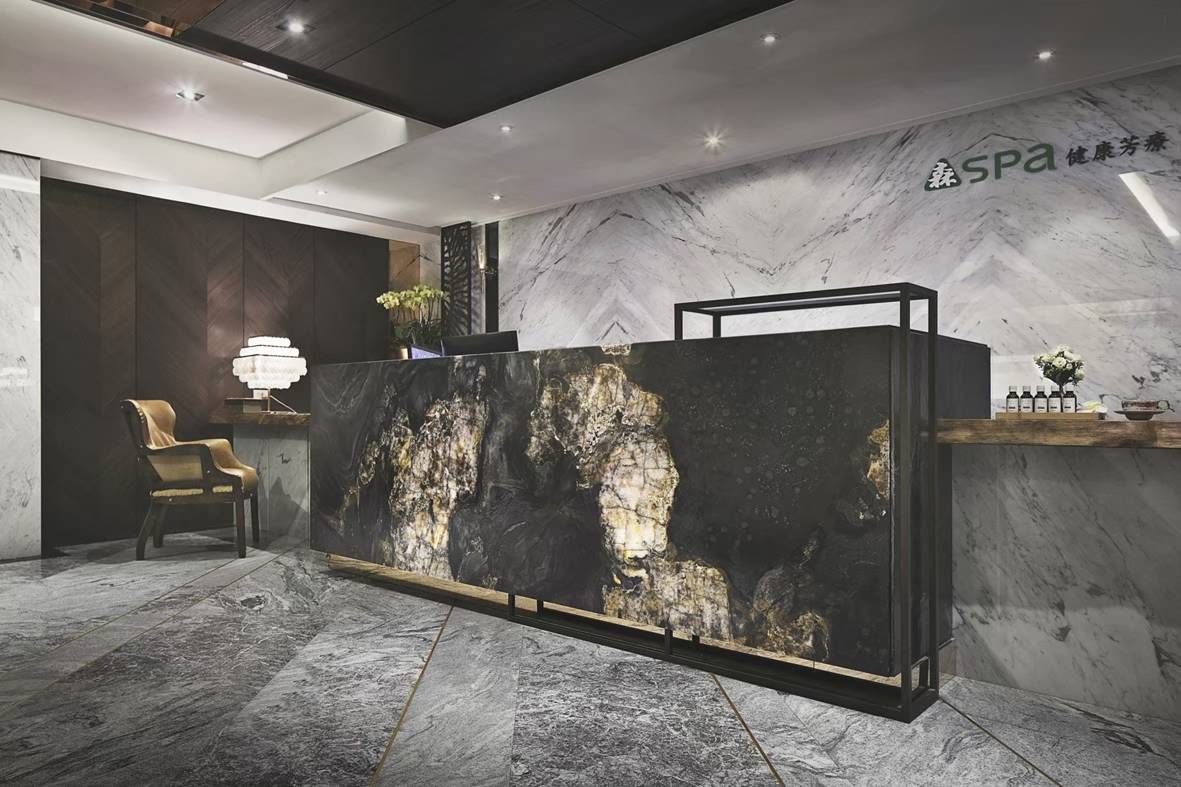
Image / 森Spa|Countertop in BELATRIX
A Personal Journey, True to the Original Vision
Why does the studio’s Chinese name, 藝念集私, end with the character 私 (sī, meaning personal or individual) rather than the identically pronounced 思 (sī, meaning thought or thinking)?
For co-founder Anita, the distinction captures the essence of their client-centred philosophy.
“思 represents the designer’s own thoughts and ideas—a one-way expression. But interior design shouldn’t work in only one direction. It has to begin with the client. Through interaction and dialogue, we shape a style together that is made specifically for them.”
The four characters of 藝念集私 describe something like a journey through design: beginning with art and craftsmanship, developing through creative ideas, taking form through collective effort, and ultimately returning to something personal—the 私.
It represents a bespoke approach shaped around each client’s individual needs, while also carrying the designer’s own creative signature. The result is something that belongs uniquely to both.
That commitment to bespoke design has led D&A interior Design to challenge convention throughout its history.
More than a decade ago, when light teak veneers still dominated Taiwan’s interiors, the studio was already commissioning furniture in darker wood veneers and experimenting with black-stained chair legs. Several years would pass before darker timber palettes became widely embraced by the local market.
Innovation has often required the designers to personally persuade craftspeople to attempt more difficult and complicated techniques simply to realise an idea.
Yet they have always embraced those challenges. Difficulty, after all, is part of what makes bespoke design truly bespoke—and part of what gives it value.
Contrary to the idea that artistic design should be spontaneous and unrestricted, Anita believes the opposite is often true.
“The more creative and experimental a project is, the more rigorous the designer has to be.”
That is why communication and interaction with clients are fundamental to the studio’s process.
Interior design is different from creating a work of art in isolation. Before a successful space can emerge, the designer must first establish a genuine connection with the client. Only then can the design respond to real needs and reflect the way that person actually lives.
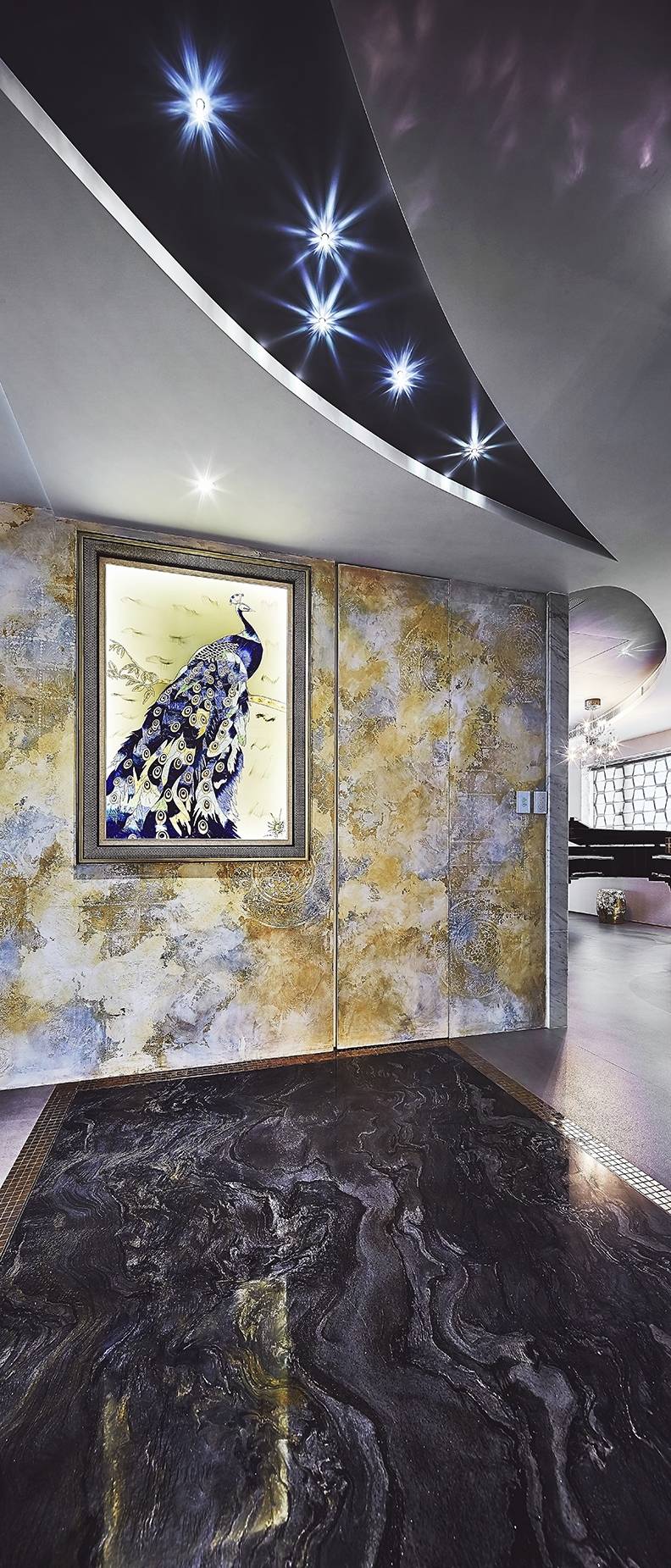
Image / Entrance of a luxury residence | AVATAR stone and lighting create a celestial dialogue between floor and ceiling.
An Aesthetic Refined Through Everyday Life
As competition within the design industry has intensified, D&A interior Design has inevitably seen its original ideas referenced and reproduced by others.
“Design will always contain elements that have appeared elsewhere. I don’t think a style itself can simply be labelled as copied or not copied. Design evolves continuously through exchange.”
But every site has different conditions, and every client has different needs.
“If someone takes another project and reproduces it one hundred per cent, the real problem isn’t imitation. It’s laziness.”
For Anita, a designer cannot rely solely on an innate sense of aesthetics. Good judgement has to be continually sharpened.
Reading extensively and studying international design projects are only the fundamentals. More importantly, the cultivation of taste has to become part of everyday life—a process of looking, experiencing, questioning, and refining one’s sensibilities again and again.
It is through this continual practice that D&A interior Design has developed spaces capable of making an immediate impression while revealing subtler layers over time.
One particularly memorable recent project is a 160-ping luxury residence inspired by the male homeowner’s fascination with astronomy and the cosmos.
At the entrance, sweeping curved light tracks evoke celestial trajectories overhead, while AVATAR Luxury Stone flows across the floor with patterns reminiscent of a moving nebula. Together, the ceiling and stone establish a cosmic composition within the relatively compact entrance.
Entering the primary bedroom, however, the visual language changes completely.
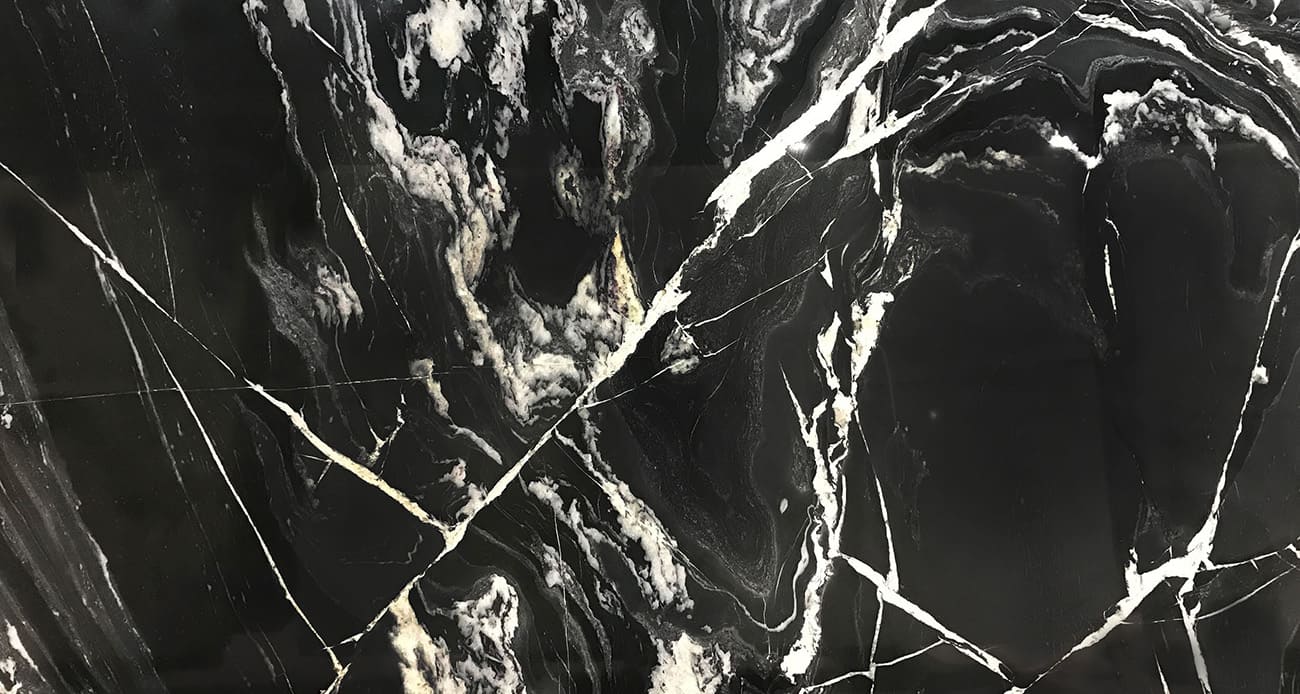
Here, Black Forest creates an elegant feature wall, its sweeping, ink-like veining reminiscent of a traditional Chinese landscape painting. Beyond it, a floral-and-bird composition appears as a delicate focal point, introducing an unexpected layer of Eastern refinement to the space.
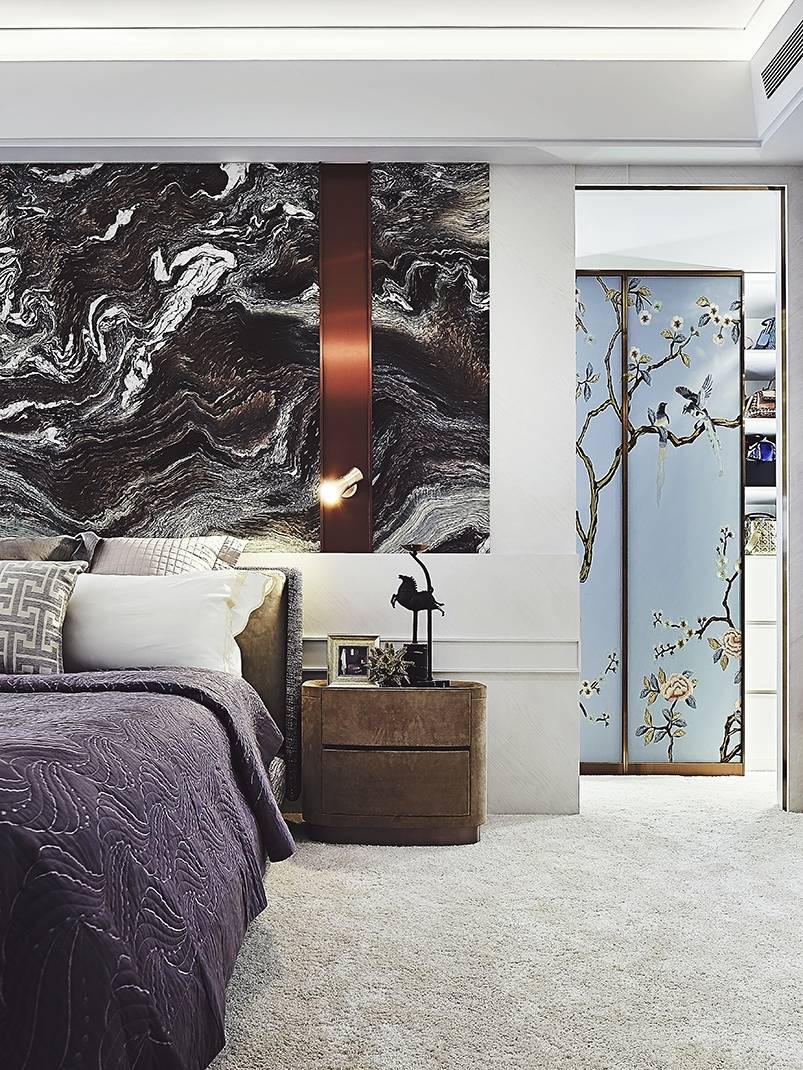
Image / Primary bedroom of a luxury residence | The elegant Black Forest feature wall brings an expressive, ink-wash quality to the interior.
Evolving with Stone
Q: D&A interior Design is known for an eclectic approach that often produces unexpected results. When incorporating stone into a residential interior, how do you select the right material for a client?
A: The first consideration is the overall colour palette of the space.
If the interior is predominantly black or dark in tone, the stone needs to have something distinctive about it. A pattern that is too ordinary can easily disappear into a dark environment, leaving the entire space feeling flat and without character.
The second consideration is where the stone will be used.
Everyone knows that the television feature wall is a place where it is worth choosing an exceptional stone, because it naturally becomes one of the main visual focal points of the living space.
Q: When selecting stone with a client, are there particular things you make sure they understand?
A: When I take clients to select stone, I usually narrow down the options first and explain which materials are appropriate for the intended environment, as well as how they should be maintained.
Stone used on floors and walls, for example, is subject to different requirements from stone used for a tabletop.
The material’s individual characteristics also matter. Some stones with highly crystalline structures can be exceptionally beautiful and translucent, but depending on the material, they may also require greater care around staining.
These are exactly the kinds of details that need to be discussed clearly before a decision is made.
Q: What are some of the different ways you use stone to create different expressions within a space?
A: When stone is used as an entrance focal point or a television feature wall, we often treat it almost like a painting.
That is why you frequently see a complete stone surface presented with minimal interruption. If you find an exceptional material, simply allowing the natural beauty of the stone itself to define the space can create an extraordinary result.
At other times, when we want the stone to relate more directly to the overall design concept, we might compose it together with leather, metal, or other contrasting materials to create a different expression.
If the design requires the stone itself to be cut or shaped—particularly into oval or curved forms—it becomes essential to understand the condition and structural characteristics of the material before fabrication begins.
That is where the expertise of the stone supplier becomes extremely important.
Q: Finally, what do you appreciate most about CHENHOW MARBLE?
A: I greatly admire CHENHOW MARBLE for having its own distinctive philosophy when it comes to building a brand.
When D&A interior Design was first established, we were among the early studios in the market to insist that professional design itself had value—and should be charged for accordingly. At the time, that approach encountered considerable resistance.
When we met clients who genuinely understood and supported that philosophy, we regarded them almost as kindred spirits. Naturally, we wanted to devote even more thought and creativity to their projects.
Good work gradually attracted media attention, and over time that helped us establish our place in the market.
I see something similar in the way CHENHOW MARBLE has built its brand. Its perspective is different from that of many other companies in the stone industry. I particularly appreciate the thought they put into naming their stone collections and products.
That is something D&A interior Design absolutely recognises and supports.
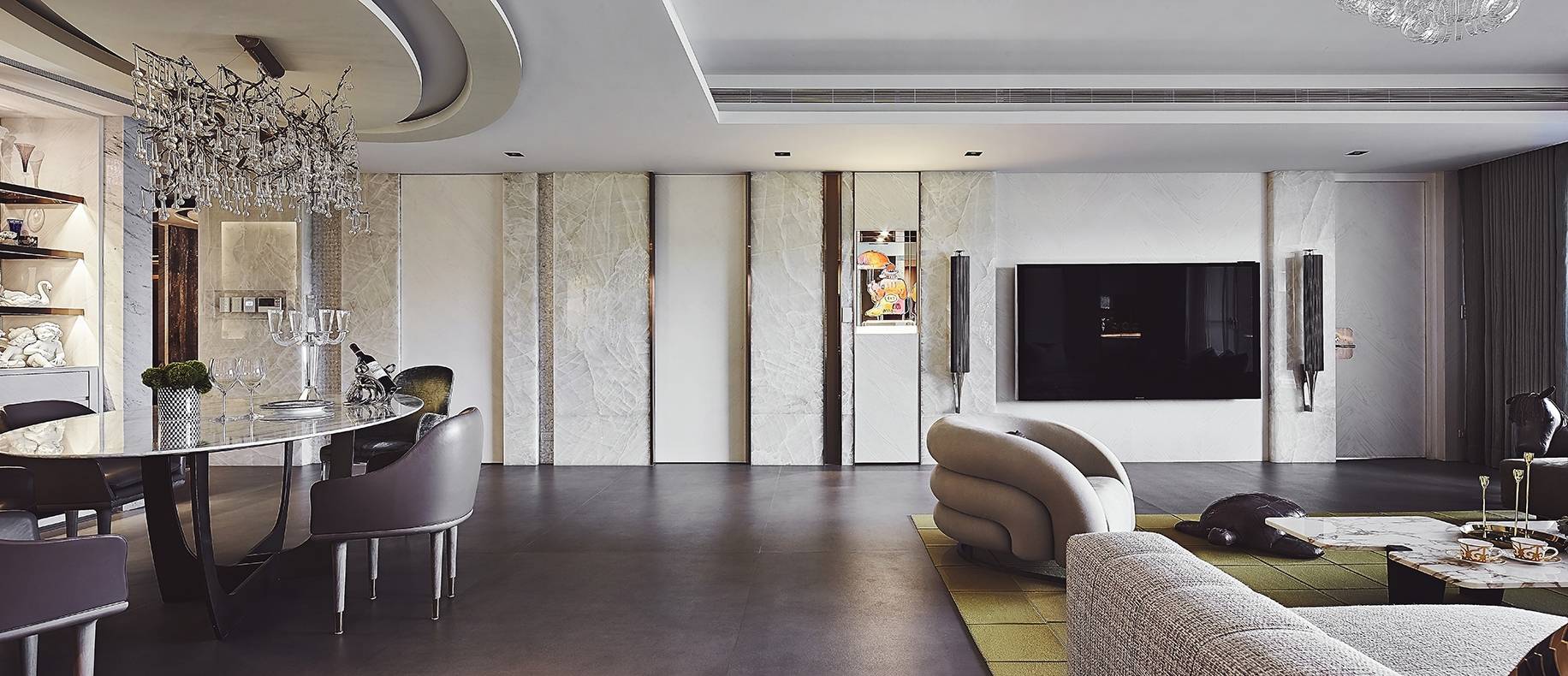
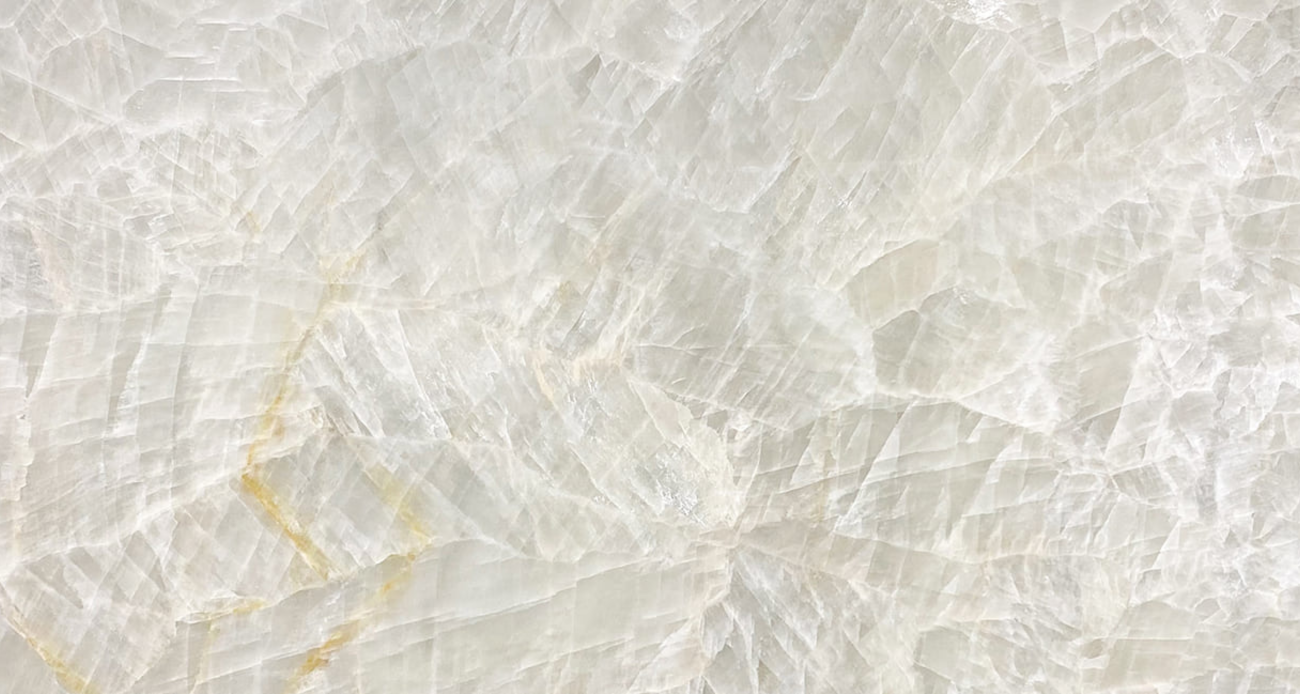
Image / Living room of a luxury residence | An elegant feature wall in Ice Age Onyx.
Epilogue
On the day of our interview, the backdrop behind Anita was the private residence she created together with fellow founder Chang Shao Hua.
The Bohemian character of the sofa and decorative objects offered an immediate glimpse into the owners’ love of art.
Yet as the conversation continued, another side of Anita gradually emerged. Behind the artistic sensibility is someone remarkably pragmatic, open, and approachable—the kind of person people instinctively feel comfortable turning to for advice.
Perhaps that explains the lasting trust she builds with her clients. Even years after a project has been completed, some still return to ask for her opinion when choosing new furniture.
For all the emphasis D&A interior Design places on originality and aesthetics, its work ultimately returns to the philosophy contained within its Chinese name: design is not simply an expression of the designer’s ideas.
It is something personal, shaped through dialogue, and created for the individual who will call the space their own.