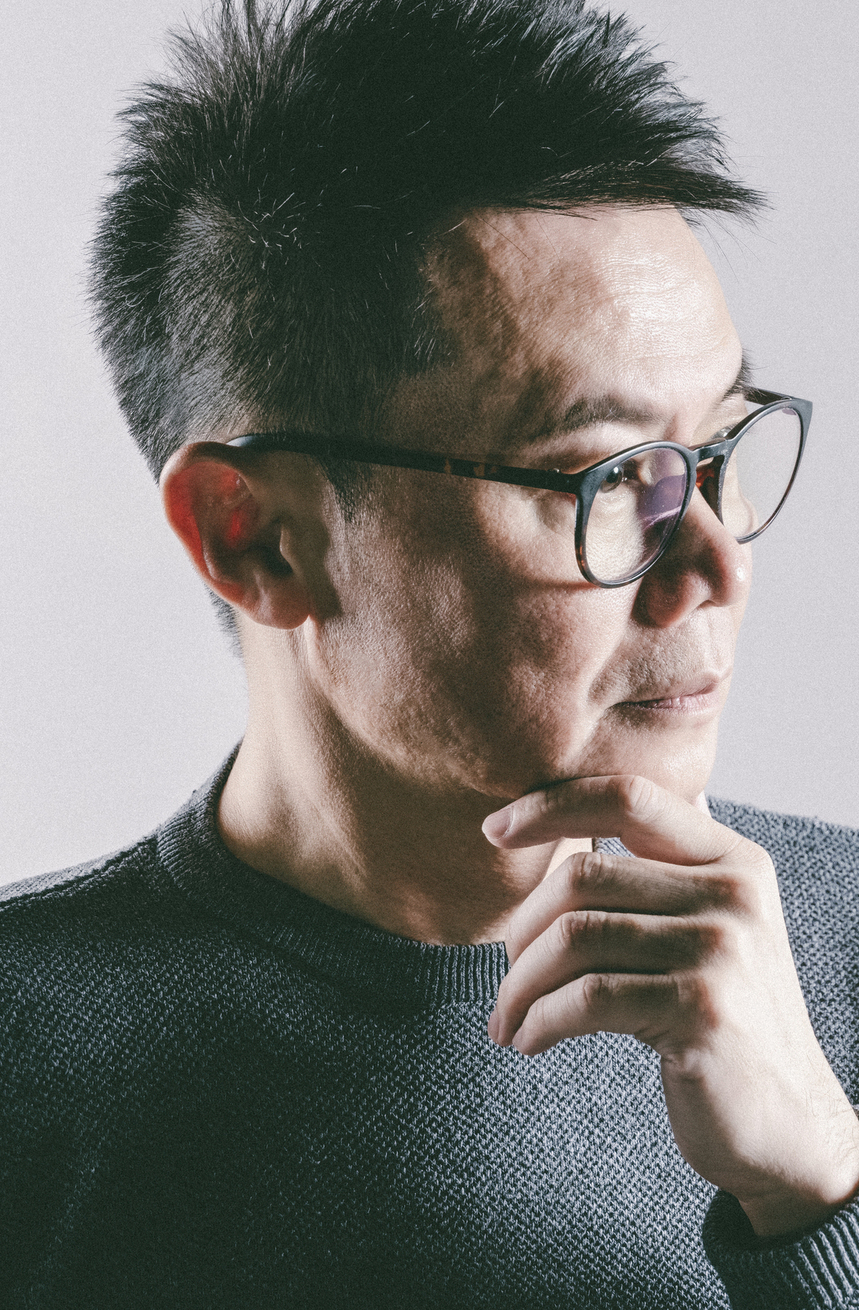
“When someone devotes so much thought and effort to buying a yacht, choosing a car, or creating the best possible home, it is rarely for themselves alone. More often than not, they do it for their family.”
— ART CHANG, Design Director
BEZALEL
With his sharp haircut, fitted hoodie, and alert gaze behind his glasses, Chang Ching Feng, Design Director of BEZALEL, has a composed presence. His expression rarely gives much away, yet when the conversation turns to the layouts and details of his projects, his language becomes precise and remarkably vivid. At the design table, one of the situations he encounters most often is a husband and wife with completely different opinions.
“My job is to stand between those differences, find common ground, and develop a solution they can both genuinely love.” That ability to reconcile contrasting perspectives lies at the heart of ART CHANG’s approach to luxury residential design.
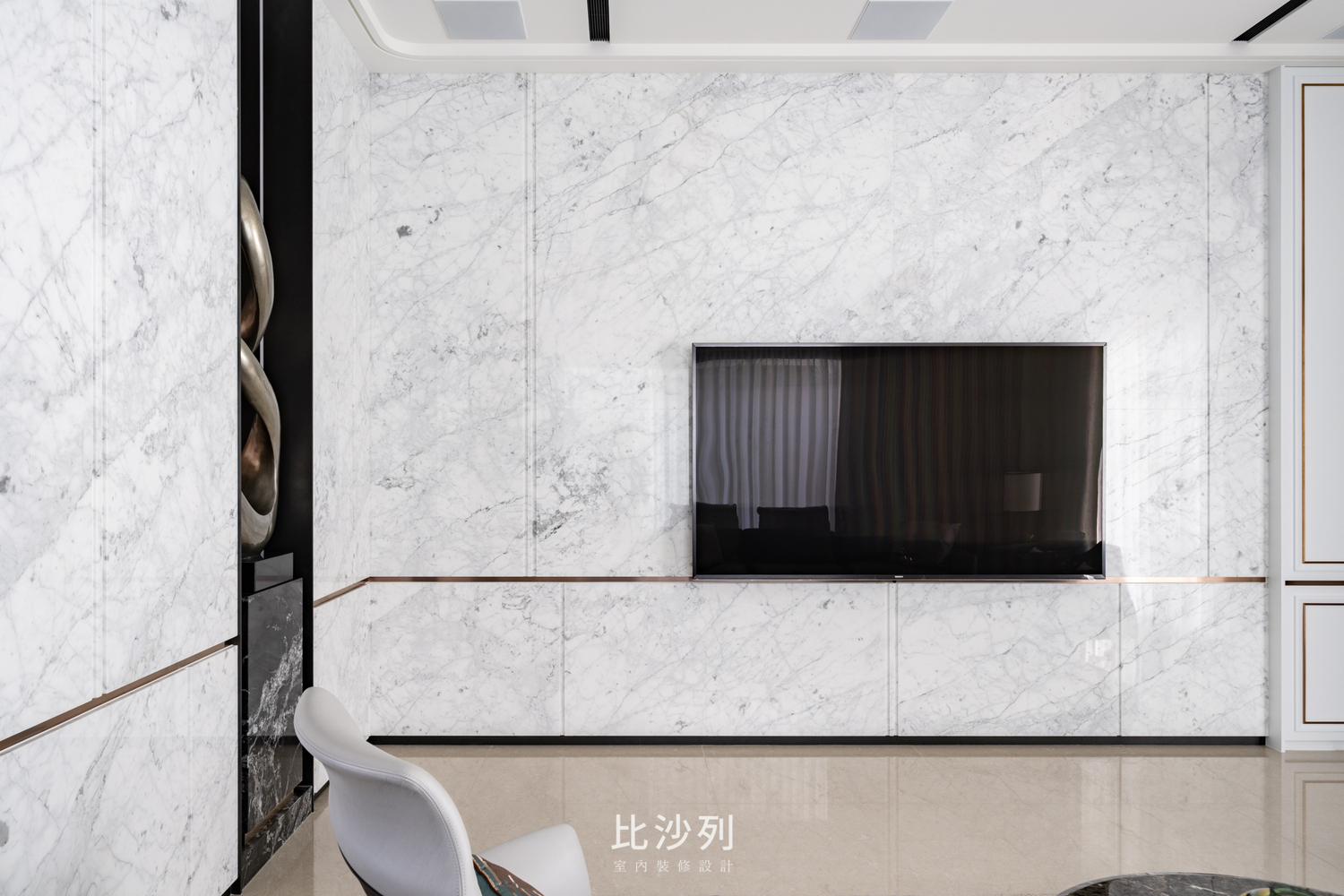
Image / Six slabs of Bianco Carrara create the visual centrepiece of the living room.
True Luxury Is a Home That Brings a Family Together
Over more than two decades in design, ART CHANG has worked with countless homeowners.
“People who have the means to buy yachts or luxury cars, and who devote enormous thought and effort to creating the best possible home, are rarely doing it purely for themselves. Most of the time, they’re willing to invest so much because of their family.”
He recalls a couple who purchased a spacious residence ten years earlier. At first, there were only two of them, so they created a single bedroom. When their first child was born, they added another. After the arrival of their second child, yet another room became necessary.
A home is organic because the people living within it are constantly changing.
“When they first got married, they never imagined their family would grow from two people to four. Ten years later, their belongings had multiplied beyond anything they expected. Eventually, they decided to remove the existing partitions and completely reorganise the layout—all because they wanted the home to bring the family together.”
From the needs of individual family members to the storage required as children grow, every design decision ultimately begins with people.
Listening to ART CHANG discuss his projects—even while simply looking through photographs on a computer—can feel like being guided through an art exhibition.
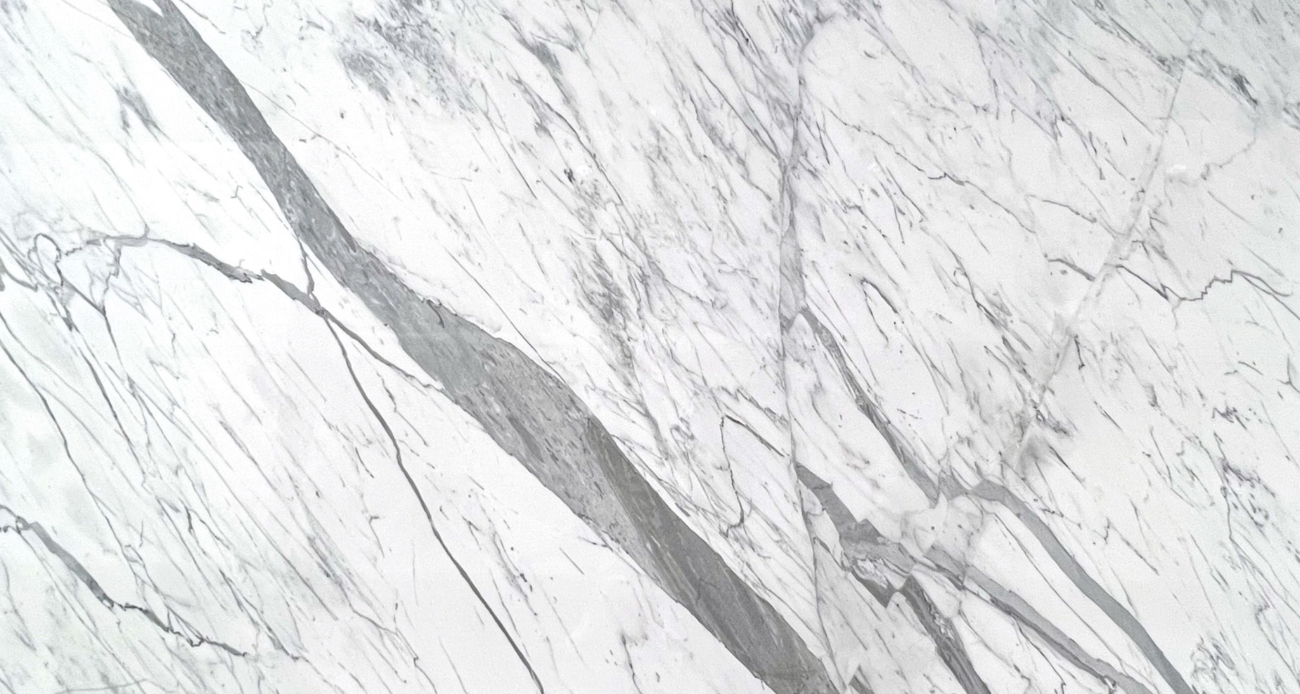
For a villa in Changhua, he searched throughout Bali District before finally discovering six slabs of finely veined Bianco Carrara at CHENHOW MARBLE, selecting them to create the main television feature wall.
Bianco Carrara itself is not an exceptionally rare stone. Finding slabs with the right clarity, lustre, and delicate veining, however, is another matter.
When homeowners choose natural stone, many instinctively regard bookmatching as the ideal presentation. ART CHANG believes this preference may partly reflect the deeply rooted cultural appeal of symmetry and paired forms in Taiwan.
“Taiwanese homeowners tend to love bookmatched stone.”
Yet bookmatching often creates V-shaped or mountain-like compositions.
“V-shaped patterns can easily start resembling animal markings or even faces. Personally, that isn’t an arrangement I usually recommend.”
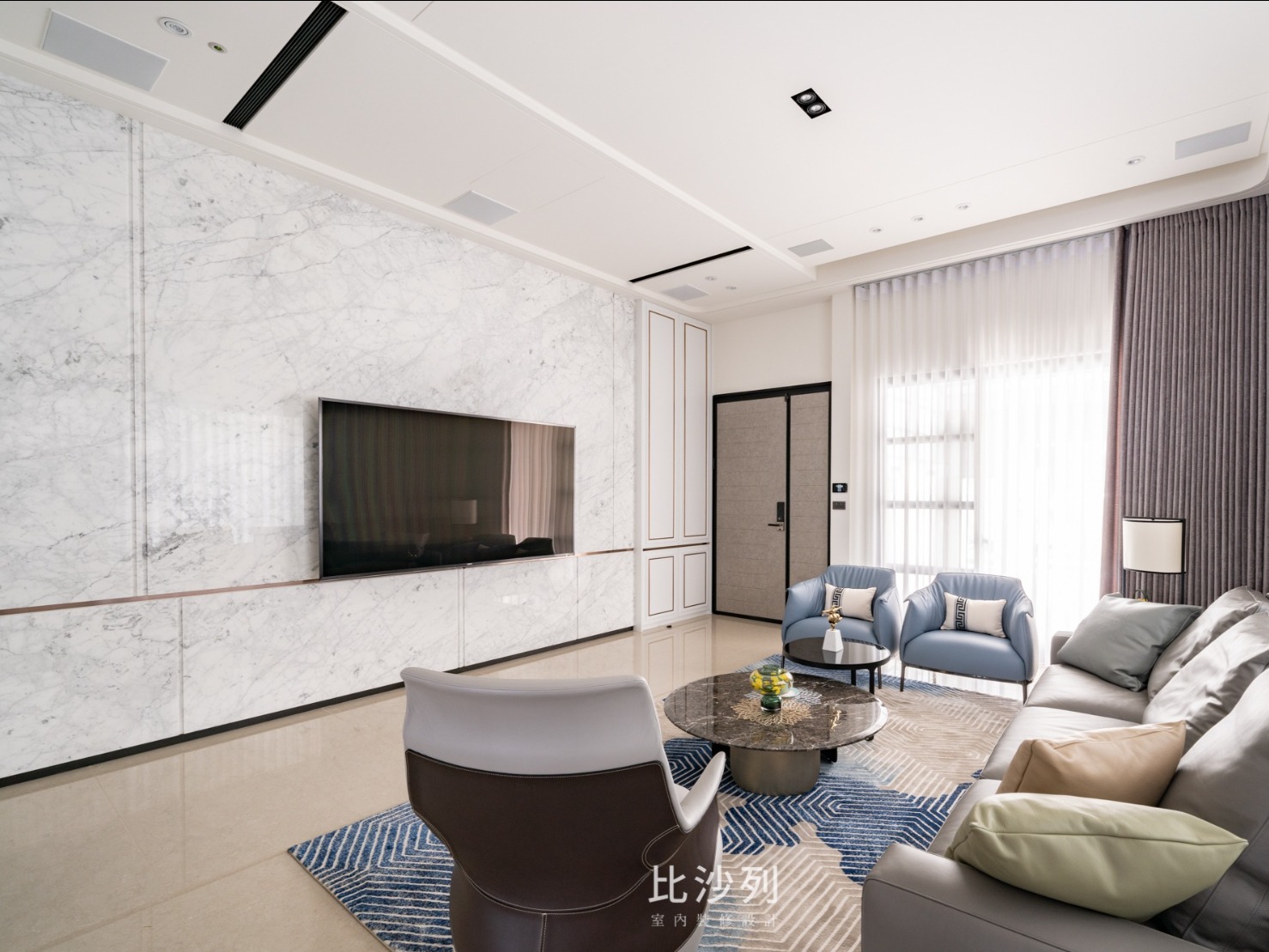
The six Bianco Carrara slabs selected for this residence possess a light, translucent quality, taking on an almost crystalline appearance when illuminated from the side.
Their fine natural fissures evoke fractured ice, while the delicate yet controlled network of lines recalls the abstract drip paintings of Jackson Pollock. The pattern is intricate without becoming chaotic, shifting naturally between density and openness to create a rhythm of its own.
For ART CHANG, one of the greatest strengths of this particular Bianco Carrara is that it does not need to rely on symmetrical bookmatching. Instead, the slabs can be arranged through continuous vein matching.
“This avoids the obvious problem of trying to force distinctive large-scale patterns into perfect alignment. Across a large surface, the continuous veining creates something calmer, more composed, and more powerful.”
The white-and-grey stone wall becomes the protagonist of the living room.
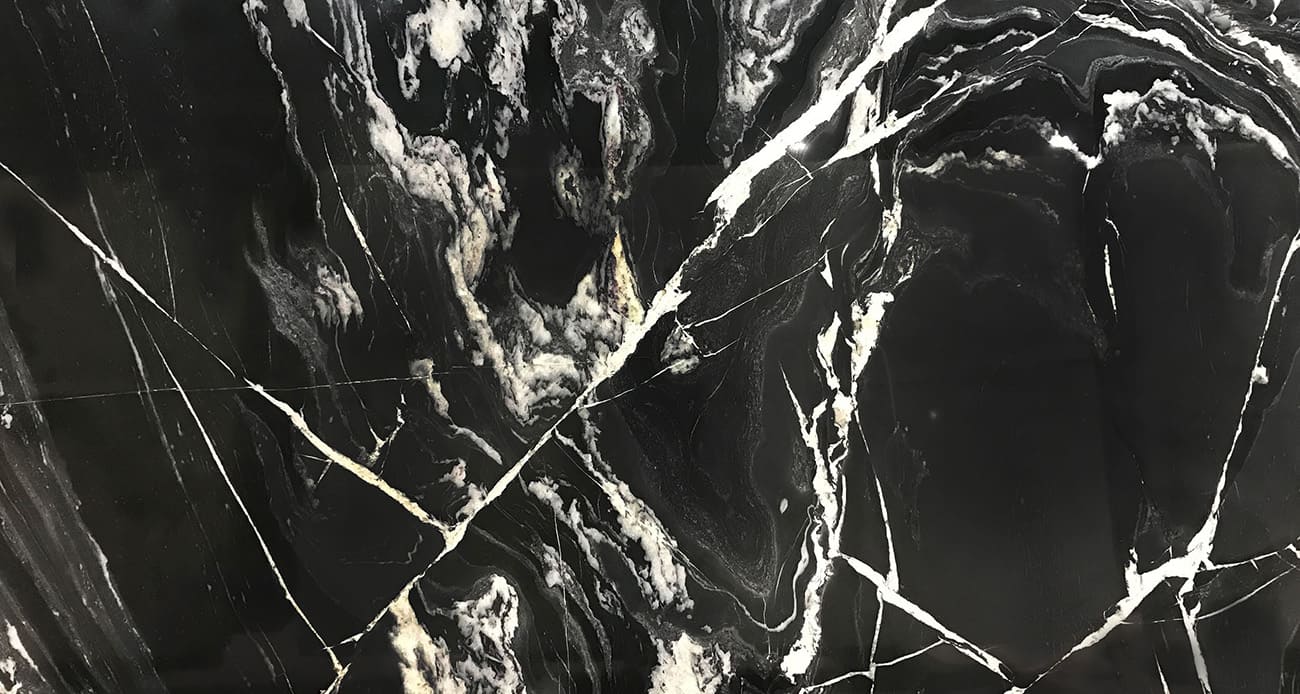
Beneath the television, ART CHANG introduced a horizontal band of titanium-finished metal with a restrained lustre, visually extending the composition. The contrasting material helps unify the transitions between individual stone panels while establishing a connection with an artistic focal point created from Black Forest stone.
“The key is finding harmony between colour proportions and geometric lines so that the composition flows naturally. When two different stones are placed together in the right way, each one becomes more distinctive.”
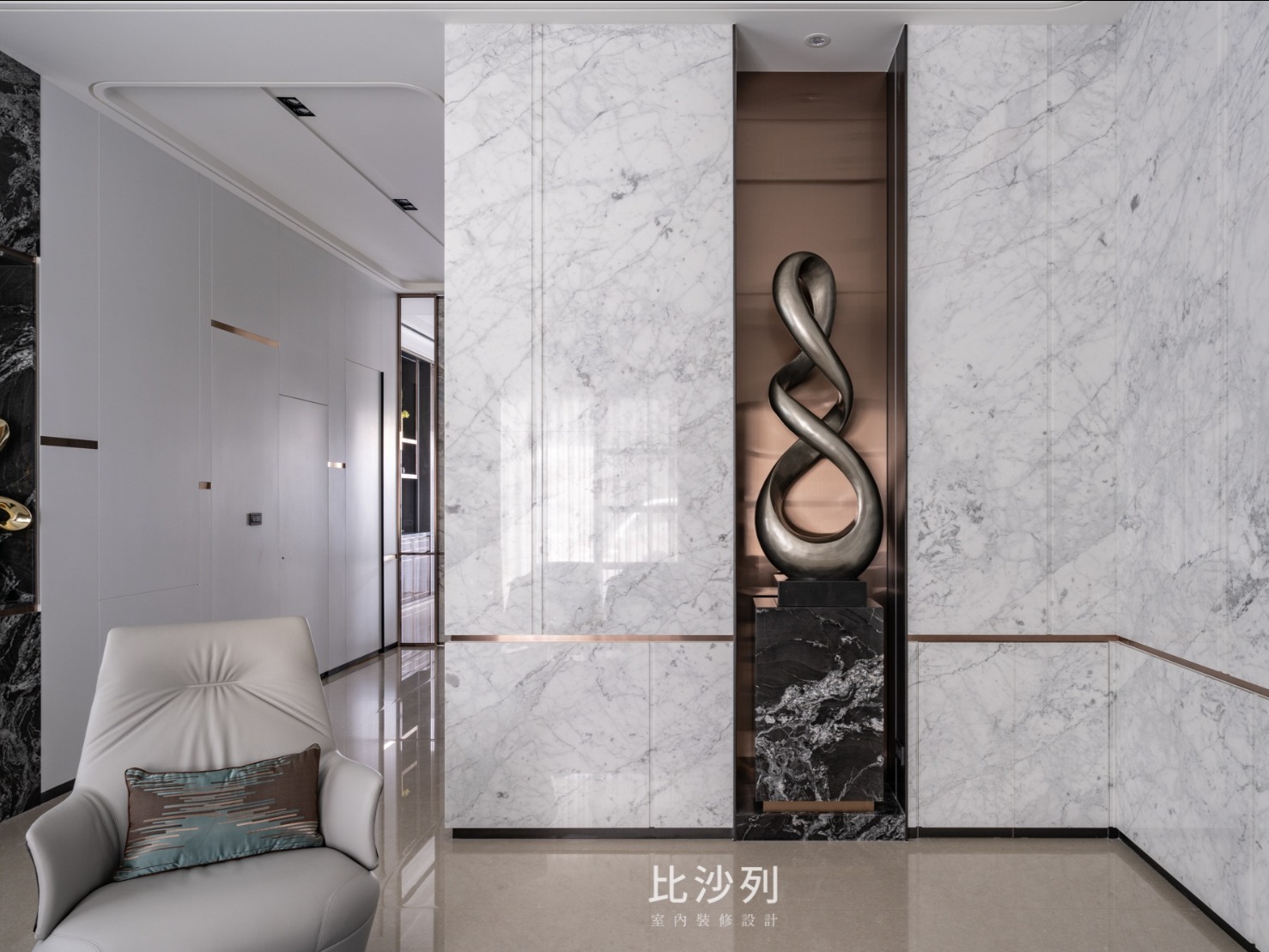
Image / The artistic focal point creates a dialogue with the main feature wall.
Let Stone Speak in Its Own Voice
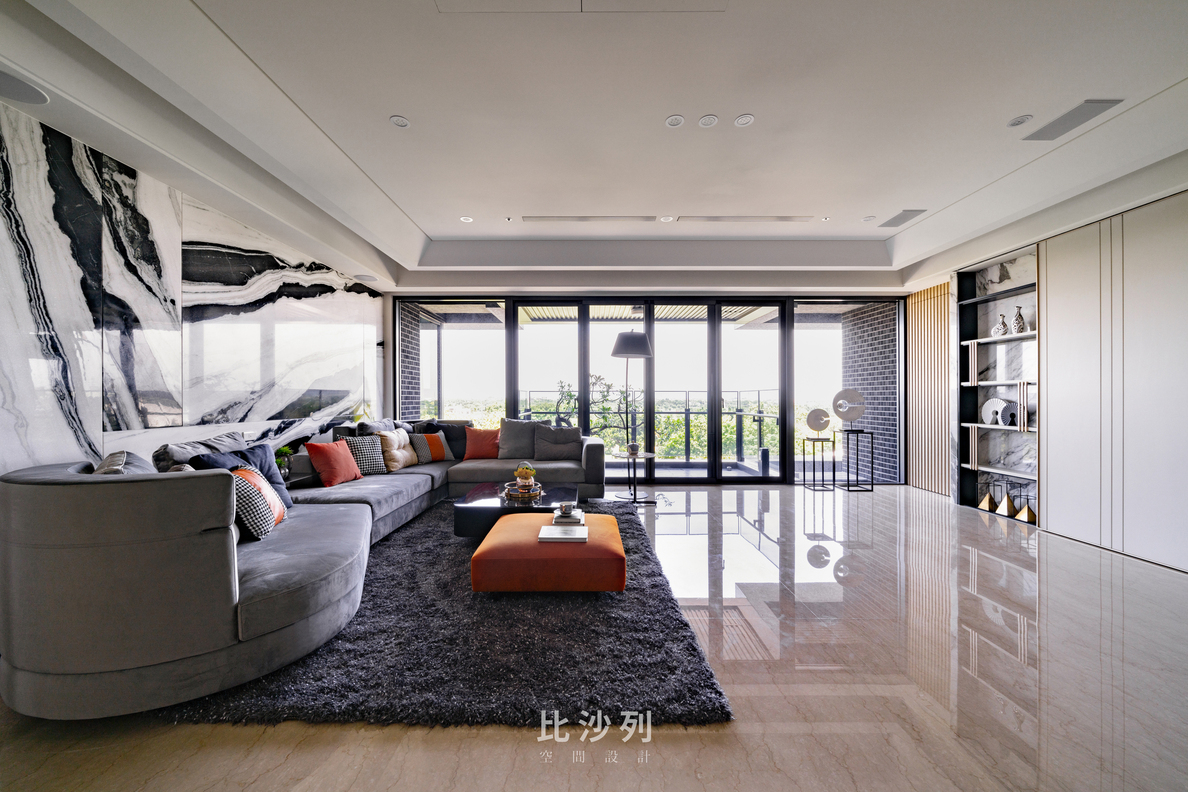
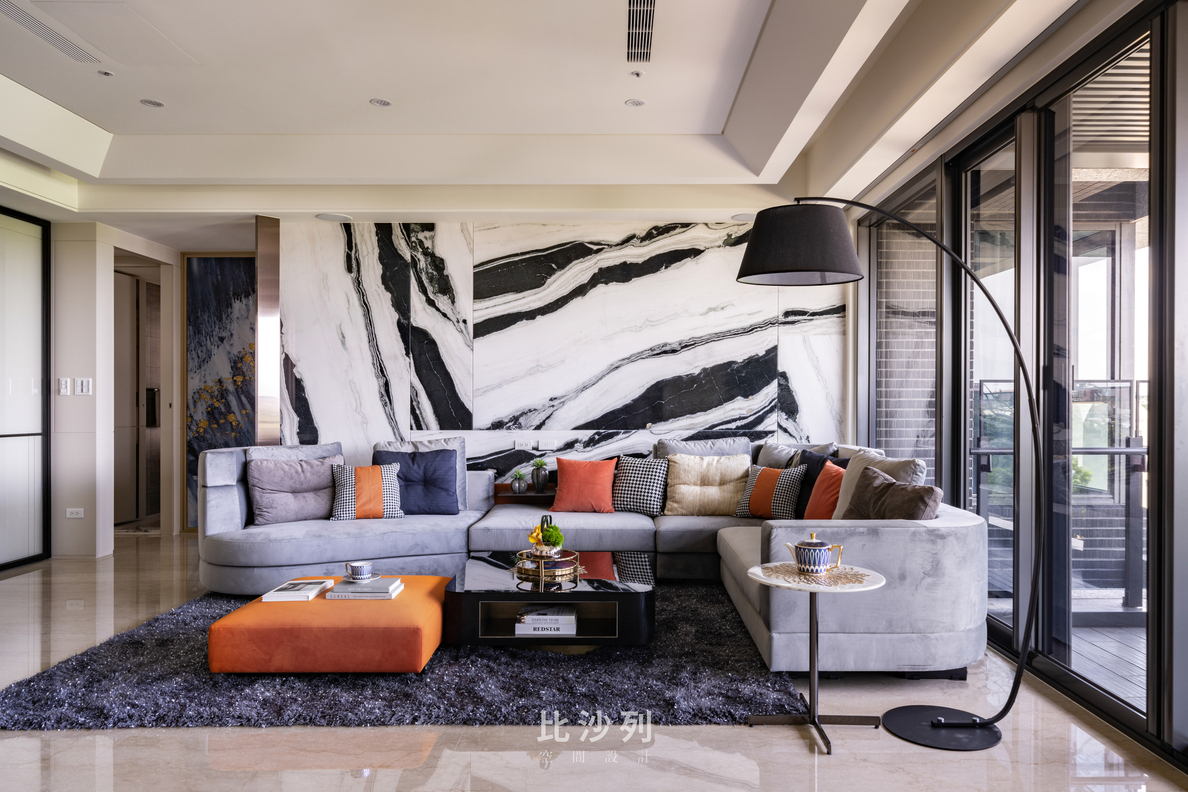
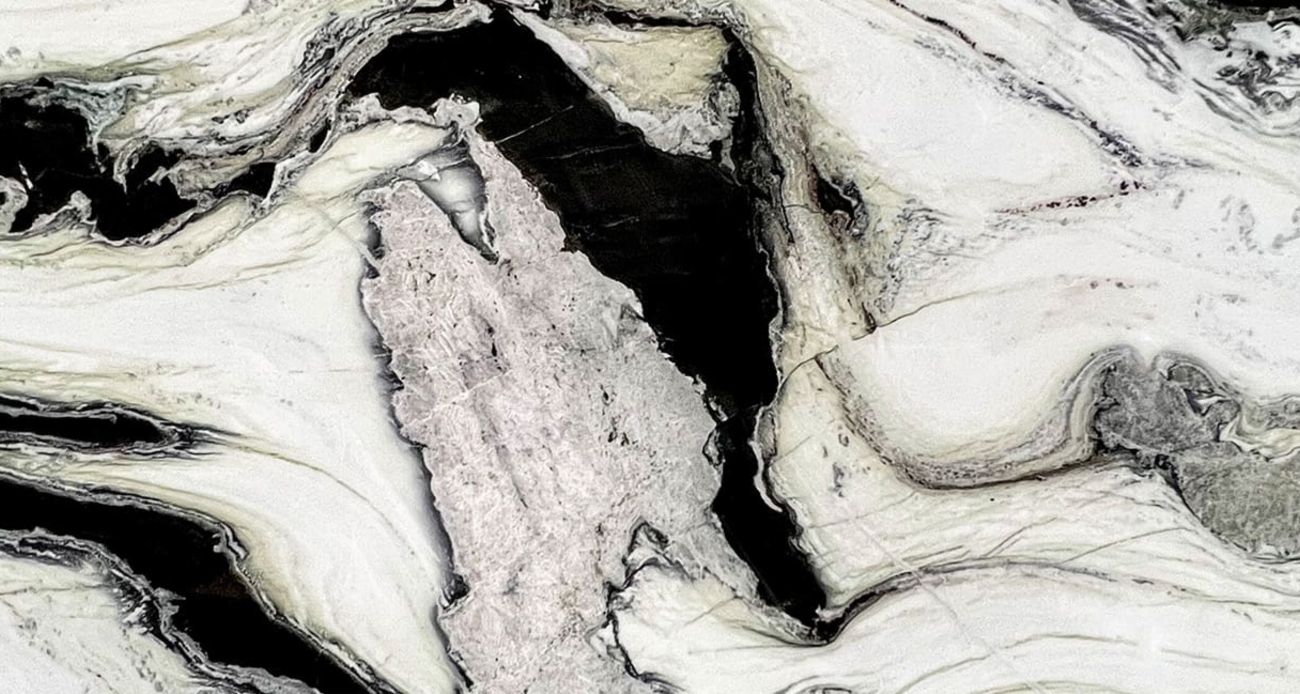
Image / Bold strokes of black and white create a composition with the presence of an abstract masterpiece | Panda White
ART CHANG approaches stone with remarkable freedom.
Throughout his work, there is a clear willingness to let natural stone reveal its original character—to allow the authenticity of the material itself to become a living part of the home.
In The Pinnacle, the moment the front door opens, the eye is immediately drawn towards the long wall behind the sofa. Like the focal point in a Renaissance painting, it establishes a visual axis with an immediate sense of impact.
For this wall, ART CHANG selected Panda White, whose dramatic and relatively uncommon black-and-white pattern reflects the homeowner’s distinctive personality.
Rather than relying on a single direction, he combined both horizontal and vertical orientations of the stone. The approach reduced unnecessary material loss while creating a composition with considerable visual force.
“The veining is broad and powerful, while the living room itself contains colourful furnishings and decorative pieces. Once the black and white enter the space, they immediately give it a very distinctive expression.”
At the corner of the feature wall, a full-height gold-toned carved panel provides a crisp transition. Its finish echoes the decorative metalwork of the display cabinet directly opposite the sofa area, creating a subtle dialogue across the room.
“Knowing how to recommend the right stone for a homeowner is part of a designer’s expertise.”
ART CHANG says he particularly enjoys taking clients to visit stone suppliers throughout Bali District.
“Finding a stone is almost like fate. You might arrive with a particular colour and pattern in mind, but once you’re there, you suddenly fall in love with something completely different from what you imagined.”
And when that happens?
He laughs. “It happens all the time. Then we adjust the colour palette and rethink how to integrate the stone into the design.”
Sometimes the right material is not the one you set out to find. It is simply the one that feels right the moment you encounter it.
Home Is Wherever the Family Is
Even the Chinese character for “home,” 家, contains an intriguing reflection of how ideas of domestic life have evolved.
According to resources from Academia Sinica, the upper component 宀 represents a house or roof, while the lower component 豕 depicts a pig. The character has traditionally been associated with an ancient domestic arrangement in which livestock were kept beneath the living quarters.
Thousands of years later, the meaning of home has changed considerably. People remain at its centre, while the pigs of antiquity have, in many contemporary households, given way to much-loved dogs and cats.
“A luxury residence isn’t defined only by extravagant design or sheer size. In many cases, it also has to accommodate a larger family.”
ART CHANG explains that at the beginning of every project, the needs and preferences of each family member have to be considered. When three generations live under one roof, the challenge becomes even greater.
“Everyone can have completely different preferences in style and colour. Sometimes they contrast with one another; sometimes they have almost nothing in common. Disagreement during the design process is perfectly normal.”
For ART CHANG, however, those differences are not simply obstacles.
“I actually find it interesting to use the design process as an opportunity to bring a family’s ideas together and find a solution everyone can accept.”
That is also where he finds one of the greatest senses of accomplishment in his work.
“If, for example, we can use the colour and character of stone to create a design that both sides genuinely love—and usually it’s a husband and wife whose preferences are very different—it feels like reaching the summit of a mountain. You’ve taken on the challenge and succeeded.”
One of the most famous stones in Chinese literary history appears in Dream of the Red Chamber.
In the novel’s mythology, the goddess Nüwa creates 36,500 stones to repair the heavens, leaving one unused. That remaining stone eventually acquires a spiritual nature and enters the mortal world as the magical jade associated with Jia Baoyu.
For ART CHANG, natural stone—formed over millions, sometimes hundreds of millions, of years—is similarly far from cold or lifeless.
In the hands of a designer, grey stone illuminated in the right way can become an elegant warm grey. It can be grounded by timber, accented with titanium-finished gold, or combined with metalwork to reveal an entirely different expression.
The material comes from nature, but thoughtful design allows its inherent beauty to become more vivid and dynamic.
Luxury Stone may bring richness and distinction to a residence, but its full potential depends on a designer who knows how to reveal the treasure within the raw material.
ART CHANG is one such designer.
Discovering Luxury Stone
Q: You use stone with great versatility in your work. From your perspective, what is the material’s greatest advantage?
A: Natural stone has been used in architecture for millennia, and one of its greatest advantages is that it can often be professionally restored rather than simply replaced.
If the surface becomes damaged, loses its lustre, or develops minor imperfections over time, specialists can often repair, refinish, and repolish it. That is a very different characteristic from many manufactured surface materials.
Marble is softer than many porcelain products, but that relative softness also means its surface can often be worked and restored. When a printed or glazed manufactured surface is deeply scratched, repairing it seamlessly can be much more difficult.
That maintainability is one reason natural stone has remained popular in high-end hospitality interiors. It can be repaired and refinished over time, whereas replacing a damaged manufactured tile can become difficult if the original model or finish is no longer produced.
For me, that is one of the fundamental differences between a natural material and an imitation.
Q: When beginning a project, what guidance do you give homeowners when selecting stone?
A: Designing with stone requires considerable experience and specialist knowledge.
Why do I emphasise expertise? Because stone represents a significant investment. Even when a homeowner has a generous budget, the designer still has a responsibility to make sure they genuinely experience the value of what they are paying for.
A designer needs to understand the characteristics of different stones and know how to advise on colour combinations. Which stones should not be used in certain situations? Which choices are likely to fail? How will different joints, layouts, or cutting methods alter the final expression?
From sample selection and design through to slab layout and fabrication, everything needs to be communicated clearly.
Most homeowners do not have extensive technical knowledge of natural stone. Ultimately, the designer’s expertise and aesthetic judgement play an important role in determining whether the material is used successfully.
Cost is another consideration. As an illustrative example, stone installation involves fabrication and labour costs in addition to the price of the material itself. Once cutting, material loss, and yield are taken into account, choosing a slightly cheaper stone does not necessarily reduce the total project cost as dramatically as people might expect.
Because installation represents a substantial cost regardless of the stone selected, I believe it is worth thinking carefully about the material itself.
Exceptional stone is difficult to find. That rarity is part of what distinguishes Luxury Stone and contributes to its value. If the budget allows, my advice is simple: choose the stone that you and your family genuinely love most.
Q: When integrating stone into an interior, how do you determine what should take priority?
A: When planning stone for a home, the first question is where it will be used. From there, we consider the specific application—is it for the floor, a wall, or another feature?
What makes natural stone unique is its natural patterning. Different stones are almost like different people: some have strong, dramatic personalities, while others feel gentle and restrained. The material has to be selected according to the character we want the space to express.
Stone is generally used in locations where it will have particular significance. Even flooring, in my view, should be treated as an important design element.
That means understanding and avoiding the weaknesses of individual stones. Some may not have sufficient wear resistance for flooring, while others can be more susceptible to changes in surface appearance over time. Once the application is established, the range of suitable materials naturally becomes narrower. That is simply part of the logic of designing with stone.
As I mentioned earlier, Taiwanese homeowners often favour bookmatching. But if you look at the interiors of many five-star hotels, you will also find more organic, non-symmetrical arrangements of natural veining that create a distinctive character.
For residential flooring, I generally recommend arranging the stone so the veining flows in a consistent linear direction. This avoids overly pronounced diamond or radial patterns and creates a softer, calmer visual effect.
For television walls, dining-room feature walls, or focal walls, however, the stone can have a much greater influence on the overall character of the interior. Depending on the scale of the surface, this may be the right place to choose a more distinctive stone with exceptional natural veining.
It may cost more, but in the right location, that material can establish the visual focus of the entire space.
Epilogue
Meeting ART CHANG for the first time, it is difficult not to be struck by the strength of his presence.
His expression reveals little emotion at first. Yet as he begins discussing his projects, a spark repeatedly appears in his eyes, accompanied by an unexpectedly open smile. In those moments, his concentration and confidence become unmistakable.
His conversation also reveals the depth of cultural knowledge behind his work. His gaze is assured, his thoughts articulate, and his vocabulary rich without ever feeling affected.
Perhaps that is precisely the kind of confidence required of a designer entrusted with creating exceptional homes—not simply spaces defined by luxury, but places capable of bringing people together.