


“The greatest sense of achievement in design comes from guiding clients to experience their own lives through the spaces we create—without ever imposing our own definition of how they should live.”
— Elen Hong, Founder
Creative Group
Creative Group is well known in the industry for its group-based management model. Over the past two decades, founder Elen Hong has continually returned to the principle that first inspired him: clients entrust designers with the freedom to design, allowing creativity to unfold, stories to be told, and a house to become a home shaped by life itself—one that speaks of the past, embraces the present, and evolves into the future.
Design Without Borders, Creativity Without Limits
In 2001, Elen founded ALLNESS DESIGN, the interior design studio that would later become a brand under Creative Group. From the very beginning, its philosophy was embedded in its Chinese name: to place the power of design in the hands of designers, giving them the freedom to focus fully on their craft. With this principle in mind, Elen set his sights on an international approach from the outset.
Through years of rapid growth in Taiwan’s property market, that original vision remained unchanged. Over time, it became one of the defining ideas that set Creative Group apart within the industry.
“Render unto Caesar the things that are Caesar’s, and unto God the things that are God’s.” For Elen, the same principle applies to the professional division between designers and engineers. It is an approach that ALLNESS DESIGN—and later Creative Group—has maintained from the beginning.
Traditionally, many interior design firms in Taiwan have operated within regional markets under an integrated “design and construction” model. Designers are often expected to assemble their own construction teams and supervise the work themselves, leaving them responsible for virtually every aspect of a project. “International design firms generally focus on design itself. From the day our company was established, our designers have specialised in design. Once a project enters the construction phase, professional engineers take over.” Elen points to the Taipei Performing Arts Center in Shilin as an example. An architect would never be expected to take on the entire construction process and then supervise the execution of their own design. Doing so would effectively make them both player and referee. Nor would it make sense to expect an overseas architect to fly to Taipei simply to supervise construction on site.
Architecture and construction are already separated by established professional and regulatory frameworks, yet Taiwan’s interior design industry has long been accustomed to bundling design and construction together.
Elen takes a different approach by having the designer’s work reviewed and executed through a separate professional team.
“Of course designers want both the design and the quality to be exceptional. But as quality rises, the budget may also increase. That’s where the engineering team steps in to manage execution, quality, and cost.” He offers another way to think about it.
“Imagine a client saying to a designer: don’t think about construction yet, and don’t worry about the budget. Just focus on creating the best possible design for me. Wouldn’t that give us a better chance of producing something truly remarkable?”
Starting from the constraints of construction, he argues, can restrict creativity before it has even had a chance to develop. Landmark projects such as Toyo Ito’s National Taichung Theater or Rem Koolhaas’s Taipei Performing Arts Center—both internationally recognised designs whose unconventional structures presented enormous construction challenges—might never have been realised if feasibility had been allowed to dictate the creative process from the outset.
“Our designers and engineers have to work things out together. Sometimes they push back against each other, disagree, or even argue. To me, that’s completely normal.”

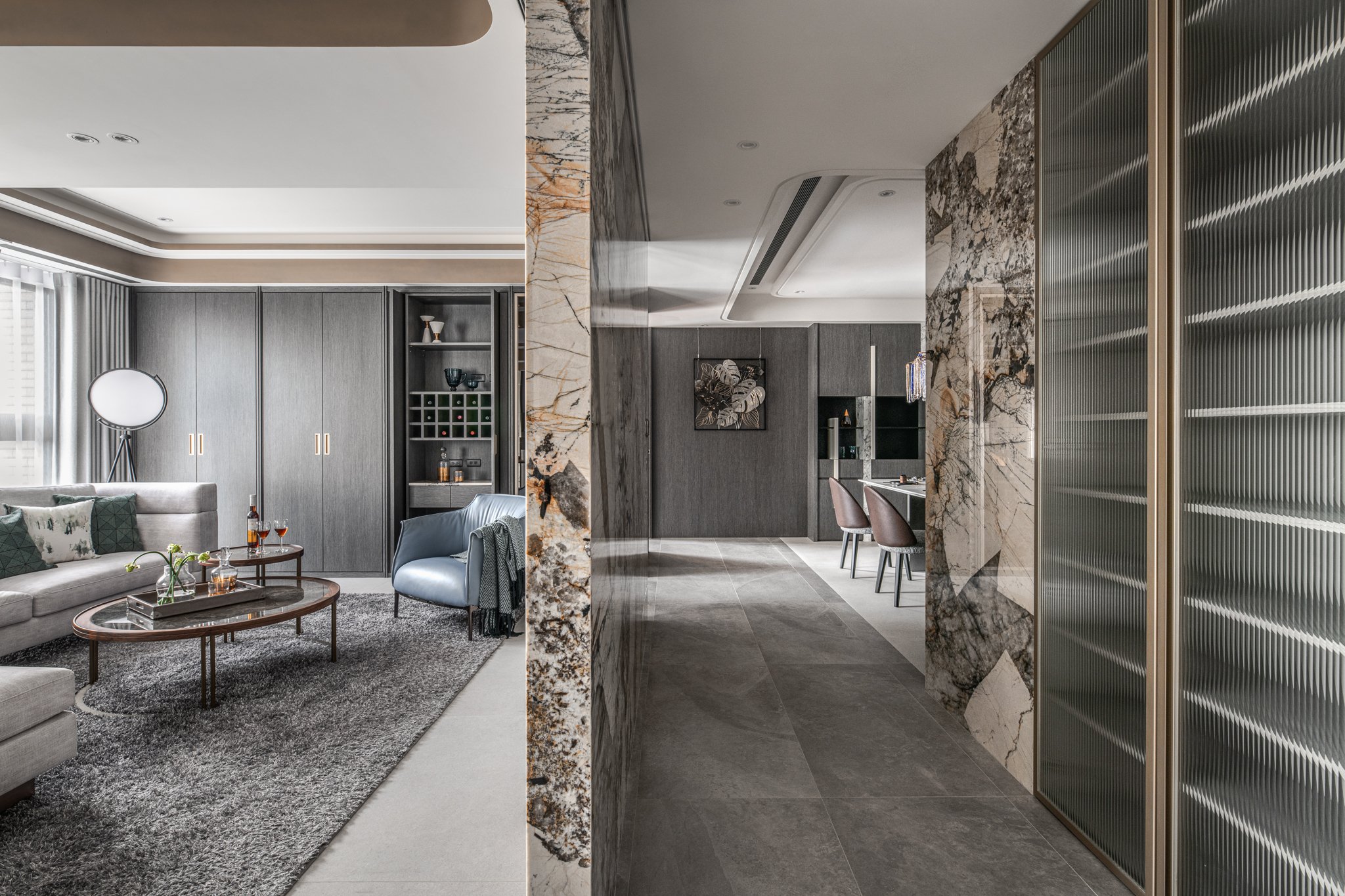
Image / Marble extends across the floor like a carpet, leading towards the dining area, where bronze-toned titanium framing draws attention to the fantastical natural patterns of “黑森林” stone. Metal and marble capture and reflect shifting light from the sun and pendant fixtures, subtly marking the transition from the main living space into the more private areas of the home.
Moving Beyond Over-Design: Less Construction, More Styling
In recent years, Taiwan has gained growing international recognition across a wide range of creative fields. ALLNESS DESIGN, a brand under Creative Group, has likewise received international recognition through the A' Design Award and Competition, reflecting the increasingly global perspective of Taiwanese interior design.
Despite his extensive experience designing grand luxury residences, Elen believes that people—not decoration—should remain at the heart of a home. Even when budgets are generous, he sees no reason to push interior construction to its absolute limit or fill every surface simply because it is possible.
With Creative Group’s work extending beyond Taiwan, Elen has travelled extensively across Europe and Southeast Asia.
“Taiwan is one of the few places where interiors are so heavily renovated. An architect completes a building, but somehow we feel we still can’t simply move in and live there. Does that really make sense? Yet we’ve become completely accustomed to it.”
He contrasts this with the way homes are approached elsewhere.
“In Scandinavia and Japan, when the architect finishes the building, much of the interior is already complete. What remains are movable elements—furniture, curtains, floral arrangements, and other furnishings.”
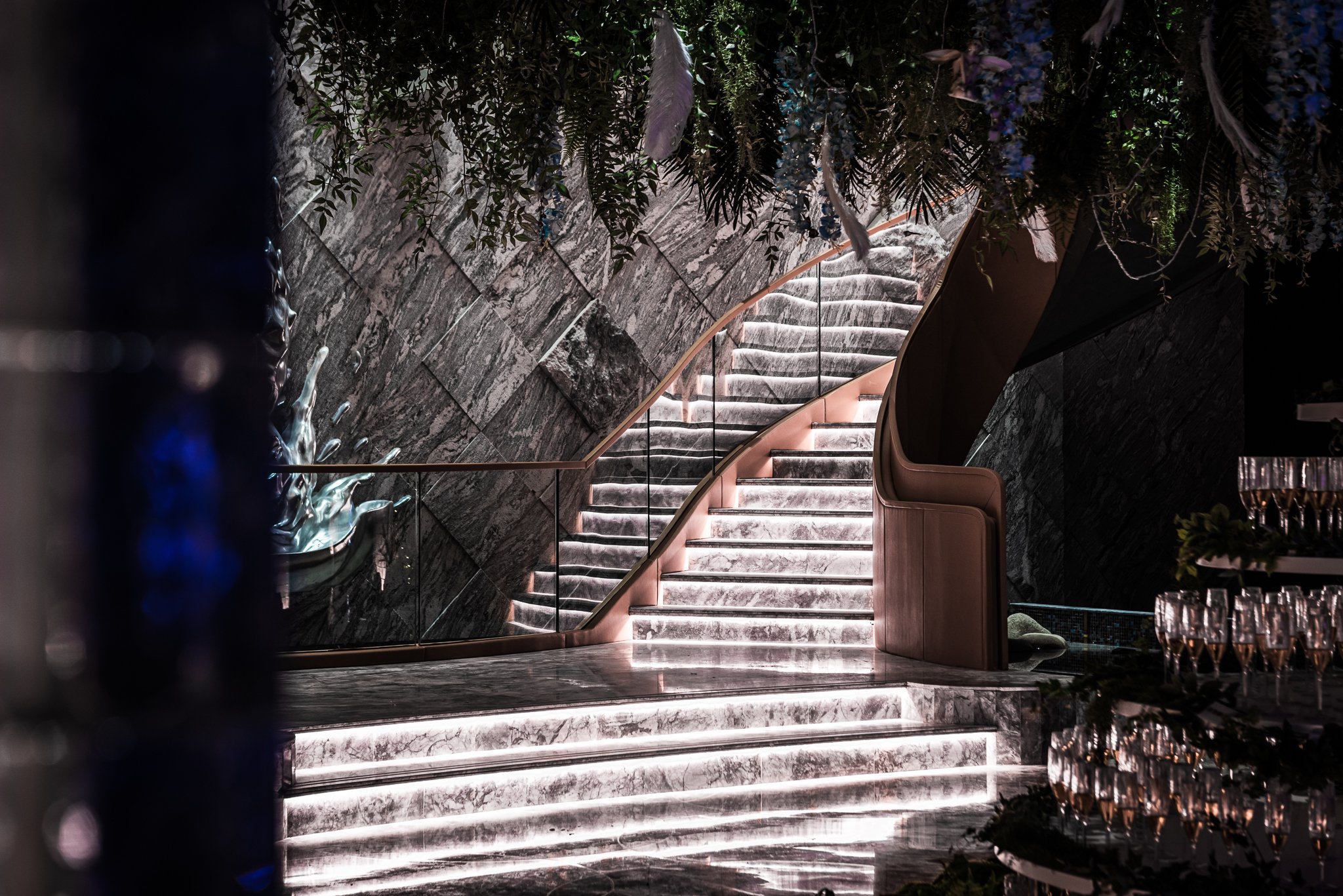 Image / At this private hospitality space in Shanghai, an angled stone wall guides visitors along a path that never fully reveals what lies ahead. Reminiscent of the winding passages of a classical Suzhou garden, the composition signals a secluded retreat hidden within the city.
The term “accessible luxury” is often associated with fashion—from jewellery and leather goods to couture. At ALLNESS DESIGN, however, Elen uses a more restrained interpretation of luxury as a central concept when communicating with clients.
For him, it means less emphasis on permanent construction and greater emphasis on furnishings, art, and objects.
Moving away from excessive renovation not only reduces the physical burden placed on a building, but also shifts attention towards the things that genuinely matter to its occupants.
“What’s important is choosing things you truly love—things that are well made and will last. It isn’t about how much you spend. Your home becomes your own personal gallery, and you can still live with tremendous quality.”
Furnishings and decorative objects become an art form intertwined with everyday life. Elen compares them to the Japanese appreciation of seasonality: like changing a floral arrangement according to one’s mood, a home can evolve with the seasons, taking on different colours and expressions throughout the year.
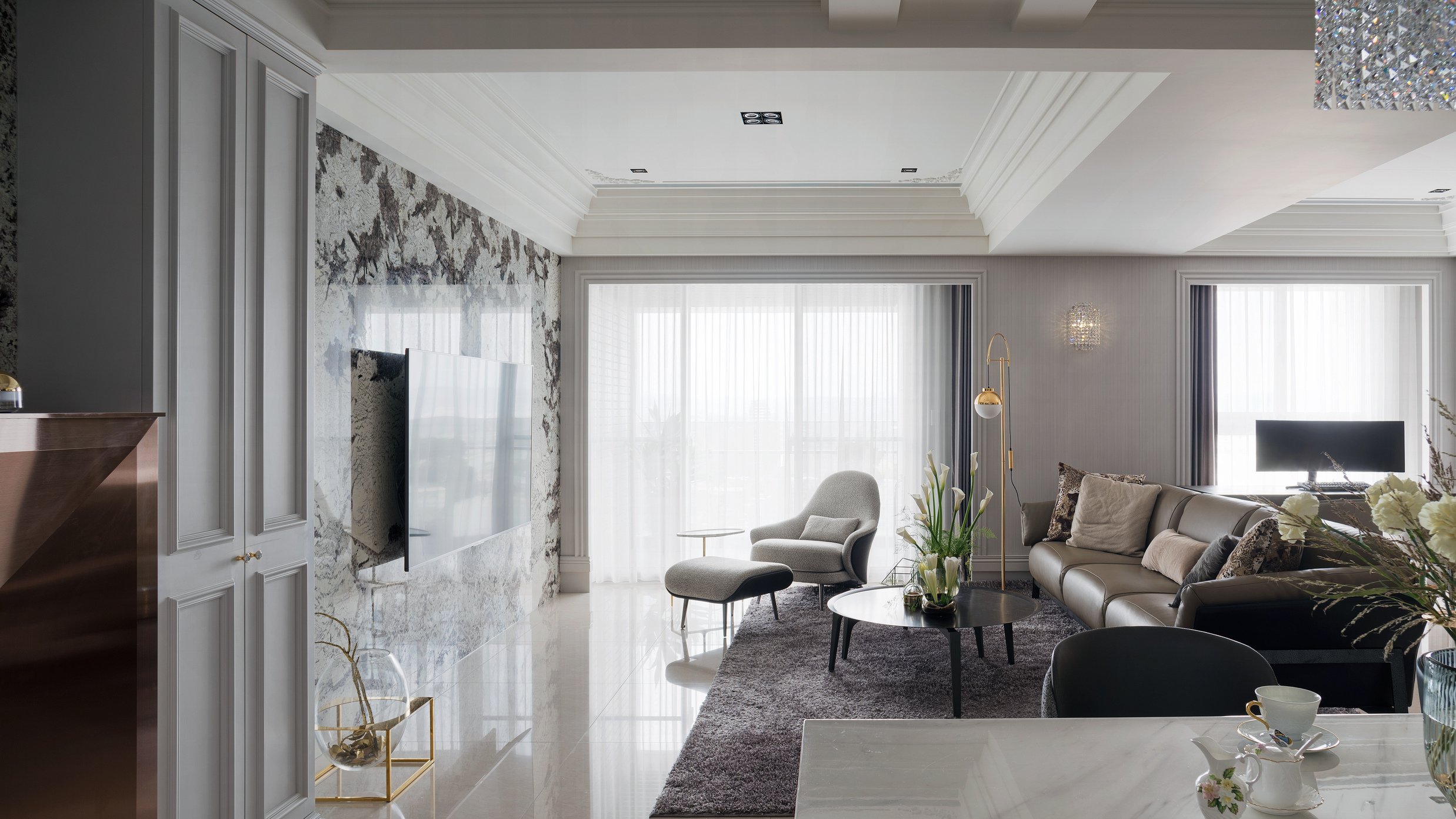 Marble formed over millions of years becomes the emotional anchor of the home, bringing a quiet sense of permanence to the grey-toned interior.
Becoming a Brand That Tells Stories
“What is the purpose of this renovation?”
It is a simple question, but one that often reaches straight to the heart of a project. When Elen asks it directly, many clients find themselves unable to answer immediately.
Why begin there?
“Clients with substantial budgets often own more than one property, and this is rarely their first renovation. Once you’ve been through the process several times, it can become routine. The emotional connection starts to disappear. It becomes: ‘Here’s my budget. Just finish the house for me.’”
Elen prefers to sit down with clients and encourage them to reconsider what the home actually means to them.
Perhaps the property is a gift for a daughter. Perhaps it will become a retirement home for two sisters. Whatever the circumstances, the purpose becomes the starting point.
From there, the team conducts an almost detective-like exploration of the client’s background, gradually uncovering the experiences, motivations, and aspirations that shape their life. Once that context becomes clear, the design objective can be defined—and the space becomes a means of achieving it.
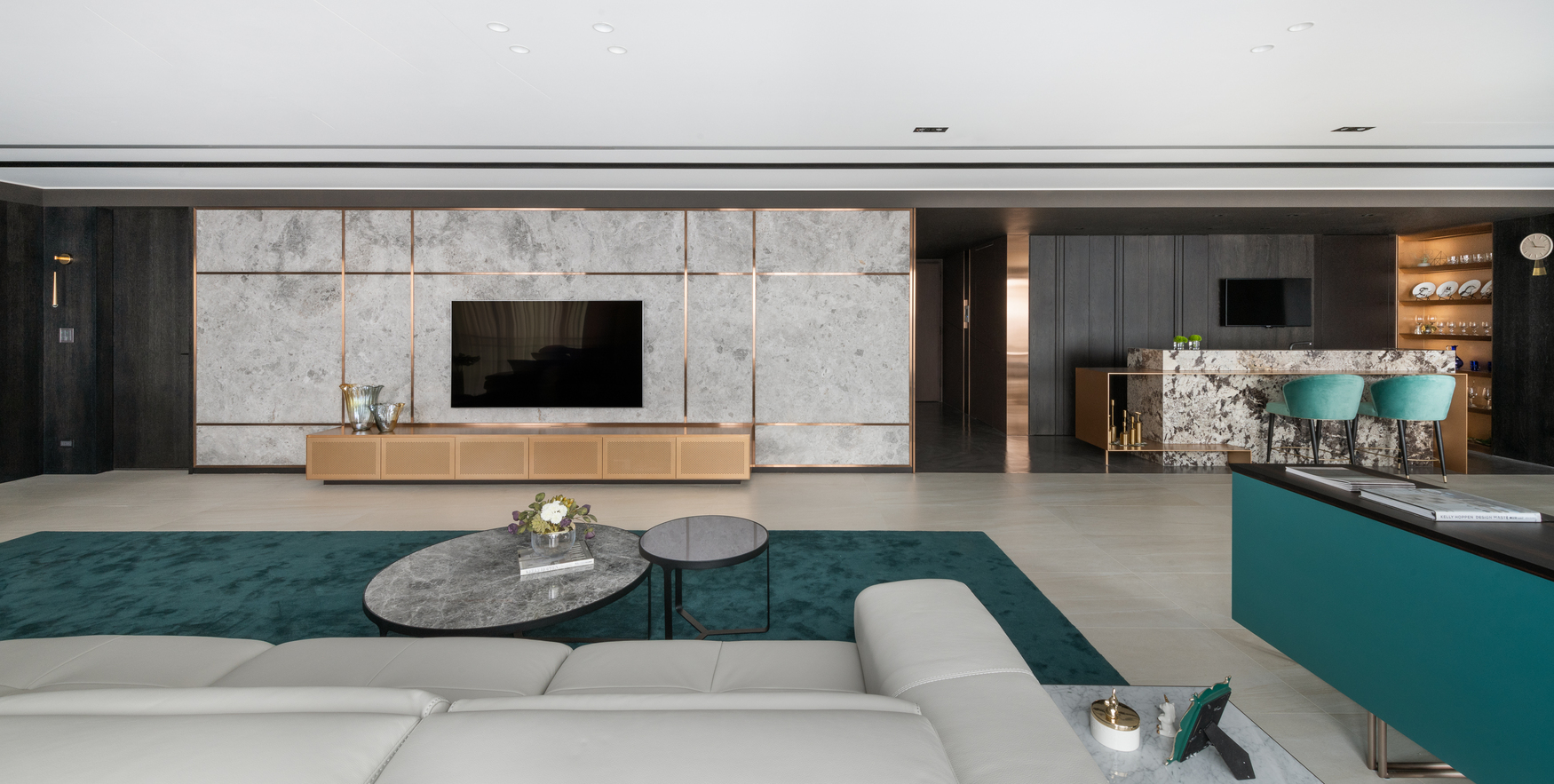
Image / Bronze-gold tones evoke the amber hues of wine, reflecting the owner’s appreciation of wine and tea. Geometric lines in stone and metal bring a rational order reminiscent of the work of Dutch artist Piet Mondrian, lending the space a composed and contemplative atmosphere.
Throughout this process of analysis and conversation, the design remains closely connected to the client’s life and personal history. These elements are woven into a coherent narrative structure, which the designer ultimately translates back into the home itself.
“We are a storytelling brand. Through design, we show clients that the space is actually a reflection of their own lives. Once they understand why we designed something in a particular way, the conversation moves beyond simply whether they ‘like’ or ‘dislike’ it.”
One recent ALLNESS DESIGN project in Banqiao uses stone from CHENHOW MARBLE as the narrative thread running throughout the residence.
The homeowner spent the earlier part of his career doing business overseas before returning to Taiwan later in life and purchasing a home.
“We’re translating the experience of his travels around the world into the space. Beginning at the entrance, we create a journey that crosses the Taiwan Strait and continues over land, with each stage of that route expressed as installation art throughout the home.”
Feature walls, for example, can be formed from pieces of marble whose natural patterns evoke elements such as oceans or great rivers. Rather than inventing those landscapes from scratch, the designers find their counterparts in stone—works of art that nature has already created. A single poem then serves as another narrative thread, connecting the entire design.
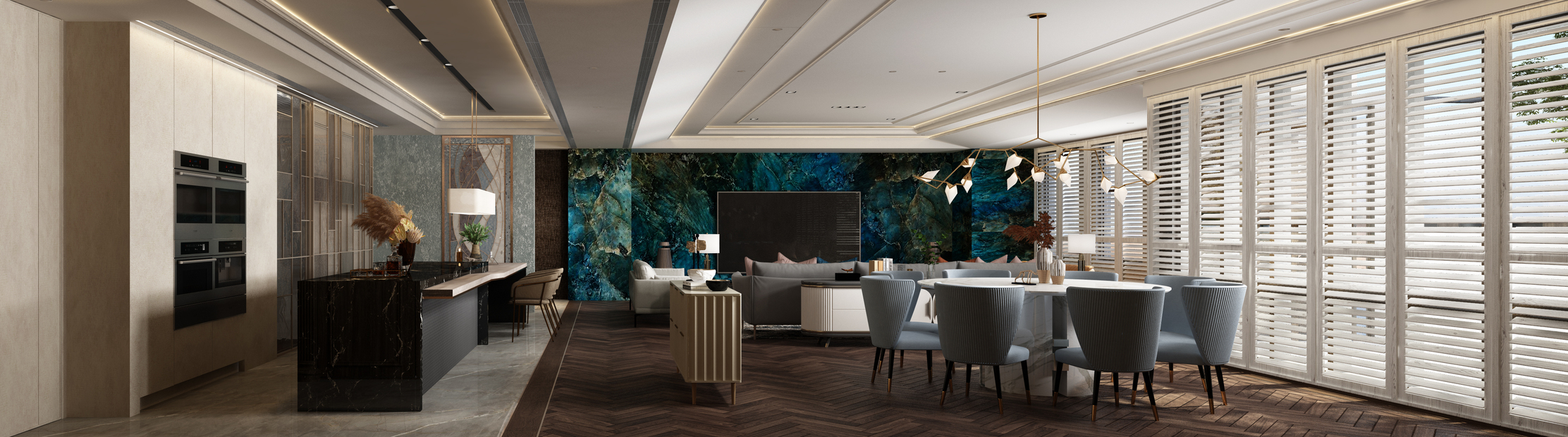
Image / An ALLNESS DESIGN residence in Banqiao—a dreamlike landscape of intertwined blues and greens, where every glance reveals something unexpected.
At the end of the interview, Elen is asked where he finds the greatest sense of achievement in his work.
He smiles. “The greatest sense of achievement in design comes from guiding clients to experience their own lives through the spaces we create—without ever imposing our own definition of how they should live.”
“That’s simply my personal perspective.”
In just a few words, he distils two decades of design experience. Perhaps this, too, is another form of giving power back to the client.
Discovering Luxury Stone
Q: How do you approach the selection and use of stone, and what do you see as its greatest advantages?
A: I’ve been working in design for more than 20 years, so I’ve encountered an enormous variety of stone. Rather than focusing primarily on price or appearance, I care more about the emotional experience a material creates.
Different combinations of stone can produce entirely different design expressions. That sensory and emotional quality comes from the material being natural—it simply cannot be replicated by something artificial. People can genuinely feel the difference.
Our group works with several stone suppliers, and among them, CHENHOW MARBLE has consistently been ahead of the curve. It was the first company I encountered that presented stone as artwork and created a distinctive experience beginning with the selection process itself.
Years ago, visiting a stone factory meant walking into a place covered in dust. You picked a slab and used it—it almost felt like choosing ingredients at a traditional market.
The first time I visited CHENHOW MARBLE, I realised someone was treating marble as something precious. The slabs were displayed with care, accompanied by information and presented with a genuine sense of dignity.
To some extent, I believe this approach also helps elevate people’s appreciation of aesthetics in everyday life, and that is incredibly important. From my perspective, CHENHOW MARBLE has successfully communicated the value that natural stone deserves.
Q: How would you describe your personal view of CHENHOW MARBLE and its materials?
A: I love selecting stone and wood. They are two of the most natural materials we can work with, and no two patterns or textures are ever identical. That gives them an inherent uniqueness and rarity.
We all know that paintings by Zao Wou-Ki can sell for hundreds of millions of dollars. I often say to clients, “Look at this piece of stone—isn’t it even more abstract than a Zao Wou-Ki painting?”
What does that tell us? Stone and wood invite interpretation. Their meaning depends on the person looking at them and the way they are incorporated into a space.
I take clients with me to select stone and timber because the selection process itself allows us to begin connecting the material with their personal story.
Stone can become a medium through which that story is told. Sometimes a slab might cost only NT$50,000, yet for that amount you are acquiring what is essentially a one-of-a-kind original work of art created by nature. It will not fade over time like a painting, nor does it require a temperature- and humidity-controlled environment for preservation.
Marble is one of nature’s purest geological creations—a material formed over immense spans of time. That is why I often use stone as though it were a painting or a work of art. To me, that is one of its greatest strengths.
With every project, I hope clients will choose stone the way they would choose art. That is how they find the piece that truly resonates with them.
When you look at stone through the eyes of an art collector, its price can seem surprisingly modest compared with its rarity—something manufactured materials simply cannot reproduce.
If you’ve ever lived in a home with marble flooring throughout, you understand the sensation. You hardly need slippers; there is an immediate physical connection with the earth beneath you.
No other building material can quite match the temperature, tactile quality, and emotional presence of natural stone. If we can bring that material into a space and allow it to speak for itself, without overwhelming it with decoration, isn’t that a wonderful idea?
Q: After more than two years of pandemic-era living, how has Elen’s approach to design evolved?
A: Our team began discussing the potential impact of the post-pandemic era on design from the earliest stages of the pandemic. Over time, however, as we continued observing how people actually lived and worked, we realised that many of the principles we had already been applying were remarkably well suited to these changes.
Whether someone is working from home or remotely from another location, many of our clients can manage what they need with little more than an iPad. In terms of design, that means virtually any part of the home can adapt naturally to different uses.
If you ask whether we need to fundamentally modify our designs specifically because of pandemic-era lifestyles, for the clients we serve, the answer is largely no.
From the study and living room to the bar area, each space is sufficiently defined to offer its own experience and level of quality, while remaining flexible enough to accommodate changing needs.
Whether someone wants an office to feel more like home, or a home to function with the versatility of an office, that adaptability is already built into the design. The spaces have been considered from multiple perspectives and planned with enough flexibility to respond to different ways of living.
In that sense, we had already been designing with the future in mind.